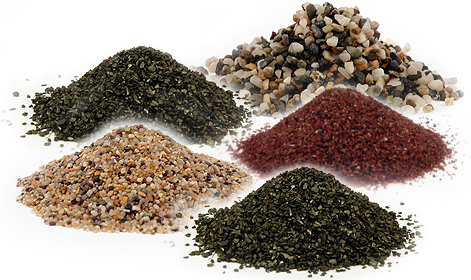
Filter Media
Sand Media
Sand media is a naturally occurring granular filtration media and it is the most widely used filtration media in pressure sand filters due to its excellent ability to remove suspended solids, turbidity, silt, clay particles, and other particulate contaminants from water. During filtration, water passes through the sand bed where suspended particles are trapped within the void spaces between the sand grains, producing clear filtered water.
Operating Principle
As water flows through the filter bed, suspended solids are physically retained within the media layers. The accumulated solids are periodically removed by backwashing, restoring the filtration efficiency.
Advantages
- Excellent turbidity reduction.
- High dirt-holding capacity.
- Chemically inert and non-reactive.
- Long operational life.
- Low maintenance requirements.
- Suitable for high flow-rate applications.
Applications
- Raw water treatment plants.
- Pretreatment for reverse osmosis systems.
- Municipal water treatment facilities.
- Cooling tower water treatment.
- Industrial process water treatment.
- Wastewater treatment plants.
- Groundwater treatment systems.
Activated Carbon Media
Activated Carbon is a premium-grade granular activated carbon manufactured using high-quality coconut shell or coal-based raw materials. The media undergoes a controlled activation process to create a highly porous structure with an exceptionally large internal surface area. This porous structure provides excellent adsorption characteristics for removing chlorine, organic compounds, color, odor, taste, pesticides, volatile organic compounds (VOCs), and trace contaminants.
Activated carbon acts through adsorption, where dissolved contaminants adhere to the carbon surface and are effectively removed from the water stream.
Operating Principle
Water passes through the activated carbon bed, allowing dissolved organic compounds and oxidizing agents such as chlorine to be adsorbed onto the carbon surface. This process significantly improves water quality and protects downstream treatment equipment.
Advantages
- Excellent chlorine removal.
- Removes unpleasant taste and odor.
- Effective reduction of color and organic contaminants.
- Protects RO membranes from oxidation damage.
- High adsorption capacity.
- Long service life.
- Environmentally friendly treatment process.
Applications
- Drinking water purification.
- Reverse osmosis pretreatment.
- Pharmaceutical water systems.
- Food and beverage processing.
- Industrial process water treatment.
- Swimming pool water treatment.
- Municipal water treatment plants.
Resin Media
Description
Cation Exchange Resin is a high-performance gel-type ion exchange resin designed for water softening and demineralization applications. During operation, hardness-causing calcium and magnesium ions are exchanged with sodium ions, producing softened water suitable for industrial and domestic applications.
Operating Principle
The resin exchanges sodium ions for calcium and magnesium ions present in hard water. Once exhausted, the resin is regenerated using a sodium chloride (salt) solution, restoring its exchange capacity.
Advantages
- Efficient hardness removal.
- Prevents scale formation.
- High exchange capacity.
- Excellent regeneration efficiency.
- Long service life.
- Superior mechanical strength.
- Consistent treated water quality.
Applications
- Water softening systems.
- Boiler feed water treatment.
- RO pretreatment plants.
- Cooling tower make-up water.
- Industrial process water systems.
- Demineralization plants.
DIRM Media
Description
DIRM is a catalytic filtration media specifically designed for the removal of dissolved Iron (Fe) and Manganese (Mn) from groundwater sources. The media consists of durable mineral granules coated with manganese dioxide, which acts as a catalyst to oxidize soluble iron and manganese into insoluble particles that can be filtered and removed.
This media is particularly effective in borehole and groundwater treatment applications where iron staining, metallic taste, and manganese contamination are present.
Operating Principle
The manganese dioxide coating catalyzes oxidation reactions that convert dissolved ferrous iron and manganese into insoluble forms. These precipitated particles are then retained within the media bed and removed during backwashing.
Advantages
- High iron removal efficiency.
- Effective manganese reduction.
- Improves taste and appearance of water.
- Eliminates iron staining.
- Long media life.
- Simple operation and maintenance.
Applications
- Borehole water treatment.
- Groundwater purification.
- Industrial water treatment plants.
- Municipal water treatment facilities.
- Pretreatment before reverse osmosis systems.
- Drinking water treatment systems.
Calcite Media
Calcite is a naturally occurring Calcium Carbonate (CaCO₃) media used for neutralizing acidic water. When acidic water passes through the calcite bed, the calcium carbonate dissolves slowly, increasing the water’s pH and alkalinity. This process stabilizes the water chemistry and reduces corrosiveness.
Calcite is commonly used when source water exhibits a pH below the recommended drinking water standard range. It provides a safe, chemical-free method of pH correction.
Operating Principle
Acidic water reacts with the calcium carbonate media, causing a controlled dissolution of calcite. This reaction increases pH, alkalinity, and calcium hardness, producing stable, non-corrosive water.
Advantages
- Raises and stabilizes pH naturally.
- Increases alkalinity.
- Reduces pipe and equipment corrosion.
- Chemical-free operation.
- Easy maintenance.
- Safe for potable water applications.
- Long service life.
Applications
- Acidic groundwater treatment.
- Drinking water treatment plants.
- Residential water treatment systems.
- Industrial process water treatment.
- RO pretreatment systems.
- Municipal water supply systems.
- CATEGORY products
- TAGS